


● {01} Working Process · Research & Verify
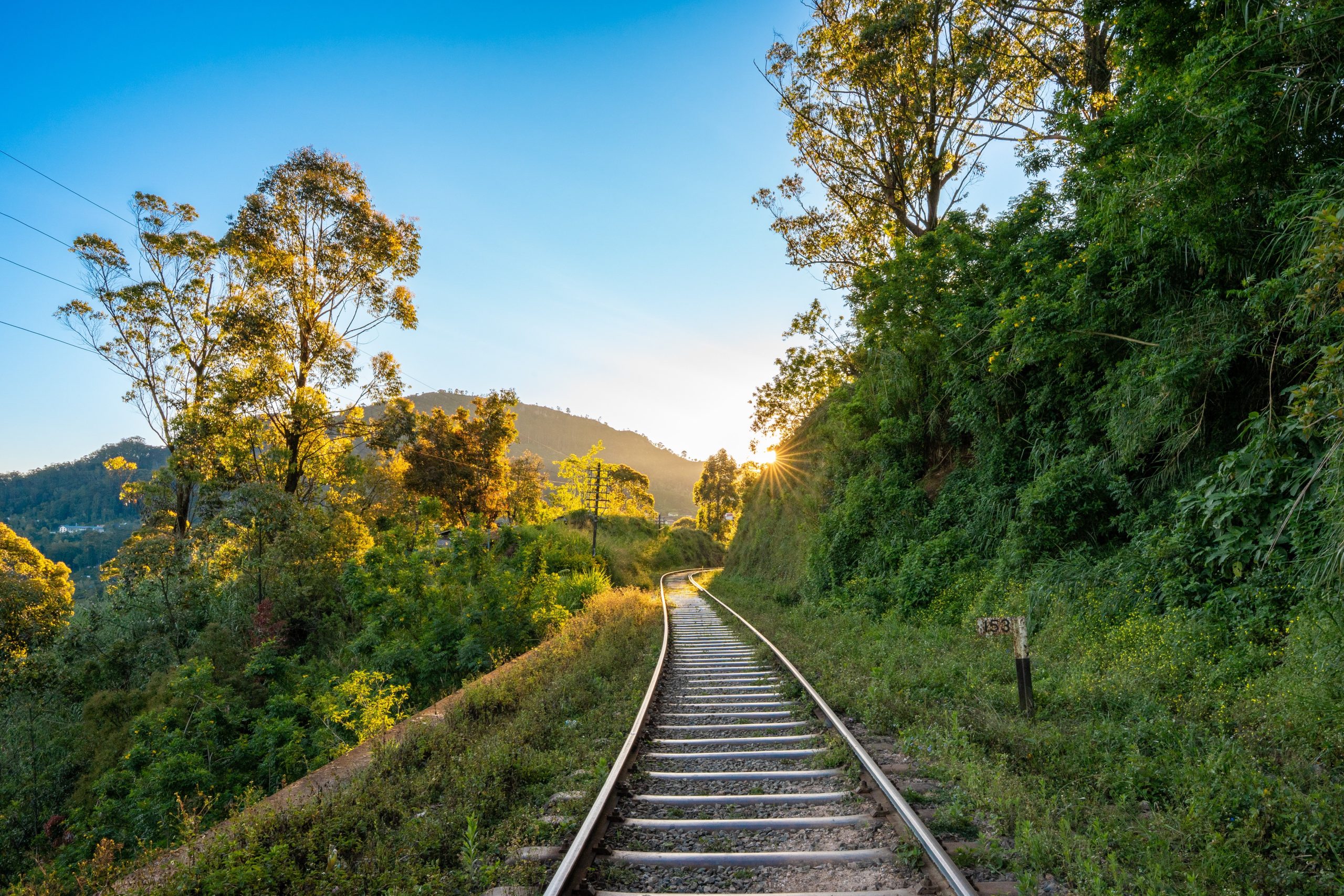
I was walking along the rails, and the line seemed to lead me straight into the heart of the hill. Green on both sides, the metal shining, and that silence you only find between one train and the next.
I stopped exactly there. The sun was starting to break through the trees. I waited until it opened into rays across the track, and only then did I shoot.
That picture looks simple. It isn’t. It is the end of a process that started long before I reached the rails.
People think field journalism starts when you arrive somewhere. It starts weeks earlier, at a desk, with questions you don’t yet have answers to. By the time I put my boots on the ground, most of the work is already done. What remains is to check, with my own eyes, whether what I read is true.
Ella, where the hill country opens
Ella sits in Sri Lanka’s hill country, where the railway climbs through tea estates, forest and cuttings in the rock. The line is famous. Travellers come for the views, for the Nine Arch Bridge, for the train itself.
But a railway is never only a view. It is a working line, run by the country’s Department of Railways, used every day by people who are not on holiday. Students. Traders carrying goods. Workers from the estates. The postcard shows the curve and the green. It does not show who depends on that line to get to work.
That gap between the image and the reality is where my job begins.
The most photographed places need the most verification
When a place appears on a million phones, everyone thinks they already know it. The image exists before you arrive. The risk is to reproduce that image instead of looking at what is really in front of you.
I have seen this happen many times, in many countries. A crew lands, films the same three frames everybody else filmed, and leaves. The result looks professional and says nothing. It is tourism with a camera, not journalism.
Research and verify is the first stage of my work, and it starts before the camera comes out of the bag. Who uses this line? Who lives next to it? What is the story the postcards don’t tell? I read, I check sources, I talk to people who know the ground. Only then do I decide what to film.
“The camera should confirm what you researched. Not replace it.”
Mohamed Bourbiza
What I do before I travel
My preparation is not complicated, but it is stubborn. I read everything I can find on the place, and then I read the things that contradict each other, because the contradictions tell me where the real questions are. I look for primary sources: official bodies, local reporting, people who live there. Wire copy and travel blogs are a starting point, never an answer.
Then I make a list of what I expect to find. That list matters more than anything I bring in the camera bag, because in the field I compare it with reality. Where the two disagree, there is usually a story worth telling.
I also decide what I will not do. No staged scenes. No paying people to perform. No filming anyone who does not want to be filmed. Deciding this at home, calmly, is easier than deciding it on location under pressure.
Walking is research
I walk a lot on assignment. Not for exercise. For information. On foot you notice what a vehicle hides: a kilometre marker at the side of the rail, the path people use to cross, the point where the track curves and the light changes through the day.
You also meet people. Walking makes you slow and visible, and that is an advantage. Nobody is intimidated by a man on foot. Conversations start because you are simply there, not because you asked for an interview. Half of what I have learned in my career came from these conversations, not from planned ones.
That morning the walk gave me the frame. The curve to the right, the hill ahead, the sun low enough to break through the leaves. I didn’t find it on a map. I found it by walking and paying attention.
Safety is part of the method
A railway is not a film set. Trains run on it, and people get hurt taking pictures on tracks. Part of research is knowing the timetable, knowing where you can stand, and stepping away in time. No image is worth a life, mine or anyone else’s.
The same rule applies everywhere I have worked, and some of those places were considerably less forgiving than a hill railway. Preparation is what keeps you out of trouble: knowing the ground, knowing the way out, knowing who to tell where you are going. Courage without preparation is not courage. It is carelessness, and it usually costs somebody else.
Verify, then trust your eye
Verification is not only for facts and quotes. It applies to images too. Is this light real, or am I going to fake it later? Is this place what it looks like? Does the frame tell the truth about the location?
I ask the same questions of my own material that an editor would ask. Where was this taken, and when? Does the caption say more than the picture can support? Would I be comfortable if the people in the frame saw the final piece? If an answer is uncertain, the material does not go out.
When the answers are clear, I can trust my eye. That is the freedom research gives you. In the field you are not searching anymore. You are recognising.
Why this stage decides everything else
Every mistake I have seen in this profession, my own included, can be traced back to research that was too thin. A name spelled wrong. A context misunderstood. A scene that meant something different from what the visitor assumed. None of it shows up while you are filming. It shows up later, in public, when it is expensive to fix.
Good preparation is invisible. Nobody watches a documentary and thinks about the weeks of reading behind it. They only notice when it is missing.
In short
— Research starts before the camera leaves the bag.
— Famous places need more verification, not less.
— Walking the ground gives you the frame a map never will.
— Decide your limits at home, not under pressure on location.
— No image is worth a risk on a live railway.
This is the first stage of my working process. The second is reporting and documenting on location, which I tell through a floating market in Vietnam seen from above. The third is editing and delivery, in the Hoi An river at sunset. Every story I tell starts the same way. On foot, with questions, before the camera.
The working process

Mohamed Bourbiza
International journalist and documentary filmmaker, founder of Euro News Agency in London. Reporting from more than 107 countries.
Featured image is illustrative.
2 Comments
[…] is the last stage of a process that starts with research and verification, on the Ella train track in Sri Lanka, and continues with reporting on location, above a floating market in […]
[…] stage of my working process. Before it comes research, the part nobody sees, which I wrote about in my walk on the Ella train track in Sri Lanka. After it comes editing and delivery, when all the material becomes a story, in the Hoi An river at […]