


● {02} Working Process · Report & Document
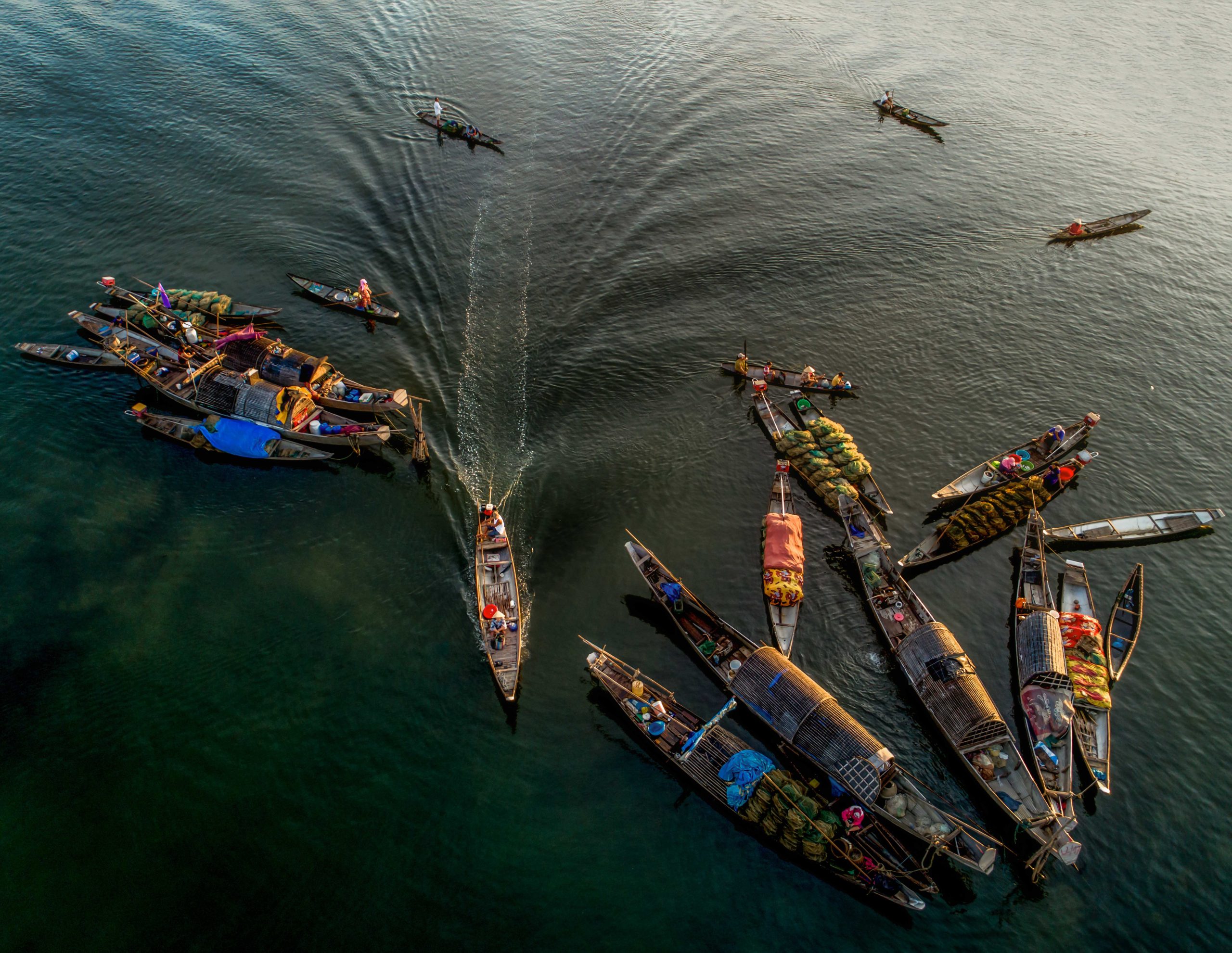
From up there, the river stopped being a river. It became a board, and the boats were pieces of a puzzle that never stayed still. Wooden hulls, goods piled under tarps, those curved roofs of woven bamboo matting. Everything moving, nothing arranged.
I was hanging above the water with one idea in my head: wait.
A market that floats because the river is the road
In much of Vietnam, the river came before the road. Families traded from boat to boat long before trucks and supermarkets arrived, and in the floating markets that logic is still alive. You don’t walk between stalls. The stalls come to you, and they leave when they want.
This is not folklore for visitors. The Mekong basin feeds tens of millions of people across several countries, and the governments that share it coordinate through the Mekong River Commission precisely because water here is economy, food and politics at the same time. When you film a market on the water, you are filming a piece of that system.
For a journalist that is a problem and a gift. A problem, because nothing stays in the same place for more than a few seconds. A gift, because nobody is performing for you. Traders have work to do. They have no time to pose.
The shot I waited for
In the middle of the scene there was a motorboat. Around it, smaller boats drifted, some tied together, some pushing off. I watched the pattern for a long time without pressing anything. I wanted the moment when that central engine would cut a clean V through the water and give the whole chaos a direction.
When it came, it lasted a few seconds. The wake opened behind the boat like an arrow, the other hulls sat at angles around it, and for an instant the market had a shape. I shot then. Not before.
“Order in the chaos is not something you create. It is something you wait for.”
Mohamed Bourbiza
That sentence is the closest I can get to explaining how I work.
Documenting is not decorating
Anyone can make a river look beautiful. Golden light, a slow drone move, music on top. It sells. But beauty alone tells the viewer nothing. For me, report and document means one thing: show what was there, the way it was there, and let the image carry information.
A good aerial of a market is information. It shows scale: how many boats, how close they work, how the river becomes a street with traffic rules nobody wrote down. It shows economy: goods covered against sun and rain, boats built to carry weight, not to look good. It shows rhythm.
What it cannot show is the sound. The voices, the engines, the bargaining. That is why the aerial is never the whole story. It is the establishing shot. After that you go down to the water, you talk to people, you record, you listen. The view from above tells you where you are. The view from the boat tells you who is there.
Flying with rules, not against them
Drone work looks effortless in the final piece. It is not. Every country has its own rules on where you may fly, how high, and near what. Permissions take time, and in some places they are simply refused. I ask before I fly, and if the answer is no, I put the drone away.
There is also a question of manners that no regulation covers. A drone over people at work is an intrusion. I keep height, I keep distance, I keep the time in the air short. Nobody’s morning should be ruined because I wanted a better angle.
Why I don’t direct people
In the field I see crews who arrive, stop the scene and ask people to do it again for the camera. Row this way. Look over there. Smile. I understand the pressure; clients want perfect images. I don’t work like that.
If I have to rebuild a moment, it is no longer the moment. It is a reconstruction, and the viewer feels it even without knowing why. So I choose the position, the light and the lens, and then I leave reality alone. My job is to be ready, not to be in control.
This costs me shots. Plenty of them. I have come home from assignments with less material than a crew that staged everything, and with material I can defend line by line. I prefer that trade.
What a market teaches a reporter
Every assignment teaches something. This one reminded me of three rules I apply everywhere, from a political story to a travel documentary.
01
System before detail
From above I understood the market in a minute. From the water it would have taken me a day.
02
Patience beats equipment
The camera was ready long before the picture was.
03
Respect people at work
They are not decoration for my frame. The market existed before I arrived, and it went on after I left.
The story is not the postcard
A floating market is photogenic, and that is exactly the trap. The real story on a river like this is rarely the colours. It is water levels, prices, who is still trading and who has moved to a shop on land, what happens to a family business when the road finally arrives.
Those things are harder to film. They come out in conversation, in numbers, in what people say when the camera is down. The aerial is how you show the reader where they are standing. The reporting is what tells them why it matters.
In short
— Order in the chaos is waited for, never created.
— The aerial sets the scene; the story is at water level.
— Ask before you fly, and keep the drone brief and high.
— People at work are never staged for the camera.
That moment belongs to the second stage of my working process. Before it comes research, the part nobody sees, which I wrote about in my walk on the Ella train track in Sri Lanka. After it comes editing and delivery, when all the material becomes a story, in the Hoi An river at sunset. Three places, one method. Go, watch, wait, and tell it straight.
The working process

Mohamed Bourbiza
International journalist and documentary filmmaker, founder of Euro News Agency in London. Reporting from more than 107 countries.
Featured image is illustrative.
1 Comment
[…] This is the last stage of a process that starts with research and verification, on the Ella train track in Sri Lanka, and continues with reporting on location, above a floating market in Vietnam. […]