


● {03} Working Process · Edit & Deliver
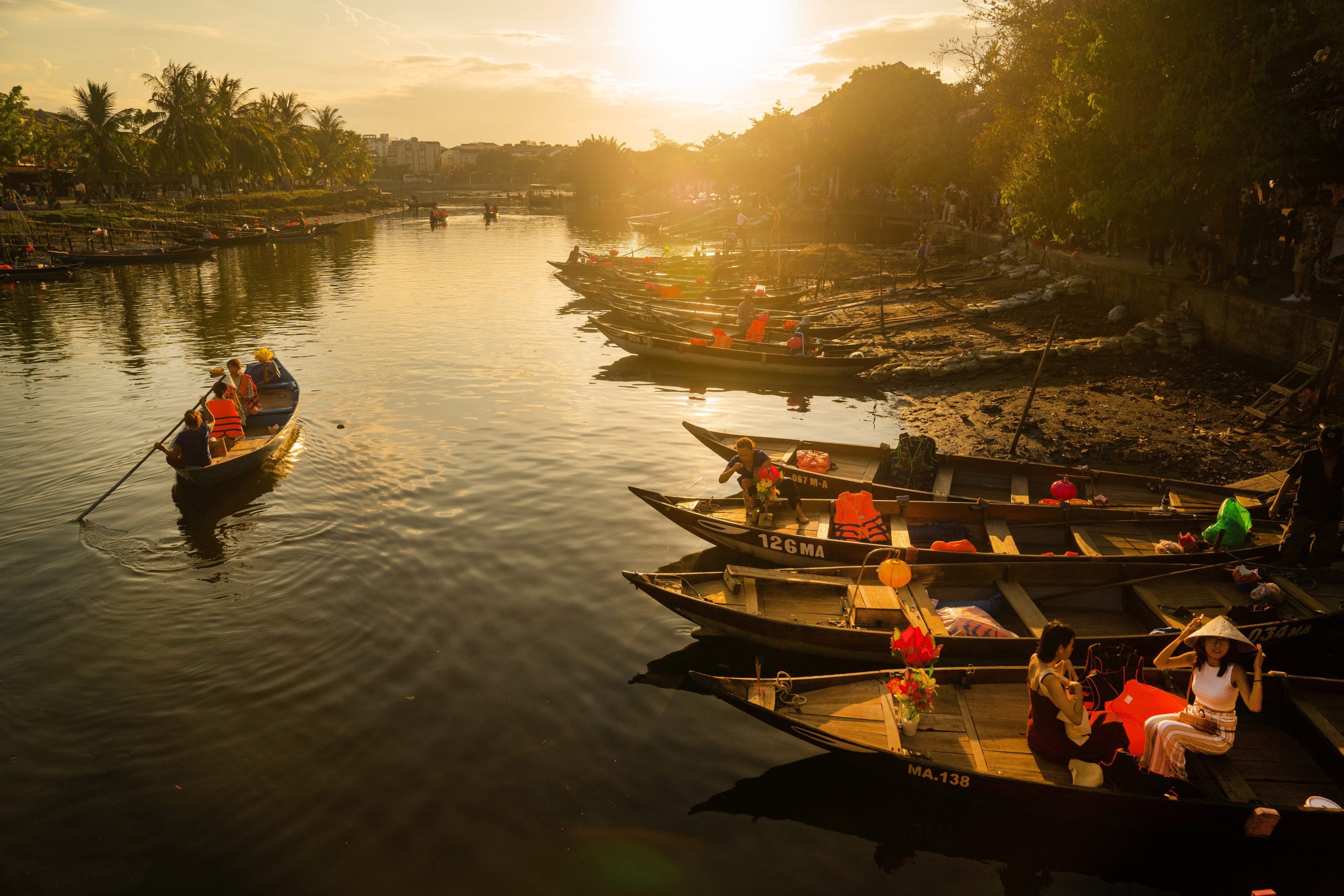
The evening was coming down, and the golden light turned the water into a mirror. I moved closer to the moored boats and shot just as the first lights came on. Incense in the air. Conical hats, orange life jackets, lanterns waking up one by one.
It lasted a few minutes. Then the light was gone and the river belonged to the night.
Hoi An and the Thu Bon river
Hoi An grew as a trading port on the Thu Bon River, and its old town is on the UNESCO World Heritage list. At sunset the river fills with wooden boats, lanterns and people. It is one of the most visited places in Vietnam, and you understand why the moment you arrive.
You also understand the challenge. Everybody films this sunset. The question is what you do with it after.
The shot is not the end of the job
Edit and deliver is the third stage of my process. Many people think the story is finished when you have the shot. It isn’t. The shot is raw material. The story is what you build with it, and what you decide to leave out.
When I edit, I go back to that evening in my head. What did I feel? The gold on the water, the first lamps, the smell of incense, the quiet between one engine and the next. If the final piece doesn’t carry that, it doesn’t matter how sharp the pictures are.
“Editing is where you decide what was true about the moment.”
Mohamed Bourbiza
Verify again
Before anything leaves my hands, I check it again. Names, places, captions, dates, the order of events. In the edit it is easy to cut two moments together and create a third one that never happened. I don’t do that. The sunset stays the sunset. The evening stays the evening.
The rules that govern this are not mine alone. Every serious newsroom works to a written code, and the principles the Editors’ Code of Practice sets out on accuracy and on distinguishing comment from fact apply to pictures exactly as they apply to words. A misleading caption is a false statement, even when the photograph is real.
Colour grading is where this gets delicate. Adjusting exposure and contrast is normal craft. Inventing a sky, removing an object, moving a subject: that is fabrication. I keep the line simple. If the change would alter what a viewer understands to have happened, I don’t make it.
Shape it for the audience
A documentary for a broadcaster, a report for a news agency, a short film for a client. Same material, different delivery. Length, rhythm and language change. The truth of the material doesn’t.
I write the way I talk: short, clear, no decoration. I cut the same way. If a shot doesn’t add information or feeling, it goes.
Commercial work follows the same discipline, with one addition: the client must know where the line is before we start. I have turned down requests to present staged footage as spontaneous reporting. Saying it early costs a conversation. Saying it late costs a relationship.
Sound does half the work
People remember images, but they believe sound. The engines, the water, the voices on the bank: recorded on location, they put the viewer in the place. Library sound laid over a foreign scene does the opposite, and the audience senses the mismatch even without naming it.
So I record more audio than I think I need, always. In the edit it is the first thing I reach for and the last thing I would cut.
Deliver on time, deliver clean
Delivery is a promise. Deadlines are part of journalism and part of commercial work. A beautiful film delivered late is a failed film. So the edit follows a fixed order, every time.
01
Select
Only the shots that carry information or feeling survive.
02
Structure
Sound, colour and rhythm serve the story, never the other way round.
03
Check and ship
Captions, names and facts one last time. Then it goes.
Archive what you didn’t use
Delivery is not the end either. The material that did not make the cut is labelled, dated and stored, with the notes I took on location. Years later it has answered questions I could not have anticipated, and more than once it has proved where and when something was filmed.
An archive is also a form of accountability. If someone challenges a piece, I can open the folder and show the raw files. That is worth far more than any argument.
In short
— The shot is raw material; the story is built in the edit.
— Never cut two moments into one that never happened.
— Record more sound than you think you need.
— Same truth, different delivery for each audience.
— Late delivery is failed delivery.
This is the last stage of a process that starts with research and verification, on the Ella train track in Sri Lanka, and continues with reporting on location, above a floating market in Vietnam. Go, watch, wait. Then cut it honest and deliver it on time.
The working process

Mohamed Bourbiza
International journalist and documentary filmmaker, founder of Euro News Agency in London. Reporting from more than 107 countries.
Featured image is illustrative.