Journalism4 min read
Field Journalism in Conflict Zones: What Decades on the Front Line Taught Me
Three decades of field experience shaped Mohamed Bourbiza’s approach to conflict reporting: preparation, verification, language, restraint and responsibility.
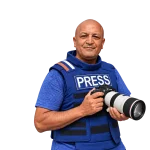 Mohamed BourbizaInternational journalist · Euro News Agency
Field Journalism · Conflict Reporting · Mohamed Bourbiza
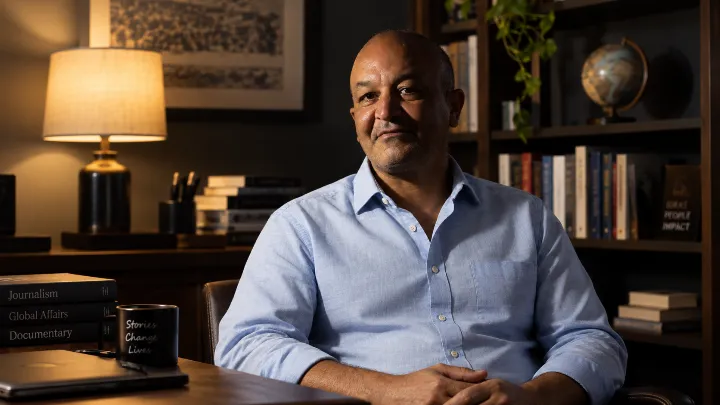
My field experience began in 1994, after graduating in Political Science from the University of Baghdad and starting an internship in Doha through a programme linked to Al Jazeera. My professional journalism career began in 1998. Decades later, the central lesson has not changed: presence matters, but preparation, verification and restraint matter more.
The credential nobody asks for
Young journalists often ask how access is obtained in difficult places. My answer is simple: you show up, you listen, and you build trust before you need it. Access is not only a press credential or a letter from an editor. It is presence, consistency and the ability to understand the people and the environment around the story.
Over the years my assignments have taken me to 107 countries across six continents. At different stages I supplied video footage, field material and reporting to international media including Al Jazeera, the Daily Mail, the BBC, Reuters and AFP — always as a freelance contributor, never as staff. A selection of that work is listed on my press page.
What the camera cannot show
Documentary filmmaking taught me something that print journalism never fully could: the weight of what is not in the frame. In a conflict zone, every image is a decision. What you record, what you publish and what you deliberately leave unseen can affect a source, a family or a community long after the assignment ends.
The camera is not neutral, and neither is the journalist holding it. Some material belongs in the public record. Some material belongs in an archive. The professional responsibility is knowing the difference.
Language is part of access
Working across Arabic, English, French and Italian has shaped the way I report. Language is not merely a tool for translation; it changes the relationship with a source. Nuance, hesitation, irony and cultural context can disappear when every sentence passes through an intermediary.
For me, multilingual reporting has always been connected to field journalism: it reduces distance between the journalist and the people whose lives are being reported.
Preparation is the real protection
Hostile-environment reporting is often described as a question of courage. In practice, it is far more a question of preparation. Before moving through an unstable area, I want to know who controls which roads, where checkpoints are, how conditions change after dark, where the nearest functioning hospital is and what alternative routes exist.
I also want someone outside the immediate area to know where I am supposed to be and when I am expected to make contact. None of this appears in the finished article or documentary, but it is part of the work.
Verification before speed
In a crisis, everyone wants to publish first. My rule is to publish right. A number that cannot be verified does not become a fact because it is repeated. A statement from one side remains a statement from one side and should be attributed as such.
When I do not know something, I prefer to say that I do not know. Restraint is not hesitation; it is a professional skill.
Fixers, drivers and local journalists
Foreign correspondents often receive the byline, but local journalists, fixers, drivers and translators frequently carry a large part of the operational risk. They know which road is safe, who can be trusted, which checkpoint has changed hands and when a situation has become too dangerous to continue.
I treat that judgement as professional knowledge, not as background support. Crediting people when it is safe to do so, paying them properly and never asking someone to take a risk I would refuse myself are basic standards of field work.
The cost nobody sees
Conflict reporting leaves marks. The profession has not always been good at acknowledging that. After difficult assignments, ordinary life can feel strangely distant, and the transition back is not always immediate.
What matters is recognising that this is part of the profession rather than pretending it does not exist: rest between assignments, work outside conflict reporting, trusted people at home and the discipline to talk about difficult experiences instead of storing them indefinitely.
What survives decades in the field
The technology has changed, the economics of journalism have changed and the speed of publishing has changed. The core transaction has not: a person has a story, and a journalist has to go where that story lives, verify it and tell it responsibly.
That principle has followed me from the first years of training, through professional journalism from 1998 onward, into documentary production, travel journalism and the later development of Euro News Agency. It remains the standard I try to apply today.
— Mohamed Bourbiza · Journalist · Field Correspondent · Founder & Director, Euro News Agency
Continue reading
- Documentary filmmaking from the field: how I approach every assignment
- Euro News Agency: independent journalism from London to the world
- Press and published work
- About Mohamed Bourbiza
Safety and duty-of-care guidance for journalists working in hostile environments is available from the Committee to Protect Journalists and Reporters Without Borders.